
Someone on your team just proposed a multi-region deployment. The pitch sounds responsible — global availability, disaster recovery, reduced latency for international users. Before you approve the architecture diagram, run the cost math. Multi-region is the right answer for about 10% of the organizations that pursue it. Here is how to figure out whether you are in that 10%.
What Multi-Region Actually Costs
Multi-region deployments cost 2 to 3 times a single-region deployment of equivalent capacity. That is not an exaggeration — it is the math.
Double the compute at minimum. Double the storage. Cross-region data transfer fees at $0.02 per GB between AWS regions. Operational complexity that multiplies engineering time: deployment pipelines that target two regions, database replication monitoring, health check routing configuration, and cross-region failover testing that has to happen regularly or it will not work when you need it.
If your current monthly spend is $5,000 in a single region, budget $10,000 to $15,000 for multi-region. The second copy of your infrastructure is not free, and the operational overhead is not zero. Before evaluating the benefits, establish this cost number in your own environment. Most organizations that evaluate multi-region honestly conclude they do not need it — they need better single-region reliability.
The Real Business Case: SLA Math
Multi-region is the right architecture when one of three conditions is true.
Your SLA is 99.99% or higher and a single-region AZ failure would breach it. At 99.99% uptime, you are allowed roughly 52 minutes of downtime per year. A single-region AZ failure that takes 30 minutes to resolve consumes more than half your annual budget in one incident. If you have contractual penalties for breaching that SLA, the cost of multi-region infrastructure might be cheaper than the cost of a single outage.
You have regulatory requirements for data residency in multiple geographies. GDPR, data sovereignty laws, or contractual obligations that require user data to be stored and processed in specific regions. This is not a performance decision — it is a compliance requirement that dictates the architecture.
Latency for users in a second geography materially impacts revenue. E-commerce conversion rates drop measurably above 100 milliseconds of page load time. If you have significant revenue-generating traffic in both North America and Europe, serving European users from us-east-1 adds 80 to 120 milliseconds of network latency that a CDN cannot fully eliminate for dynamic content.
Wrong reasons to go multi-region: technical prestige, vague disaster recovery goals without specific SLA numbers, or a single engineer who wants to build it. Calculate the cost of downtime at your SLA tier versus the cost of multi-region. If the math does not work, it does not work.
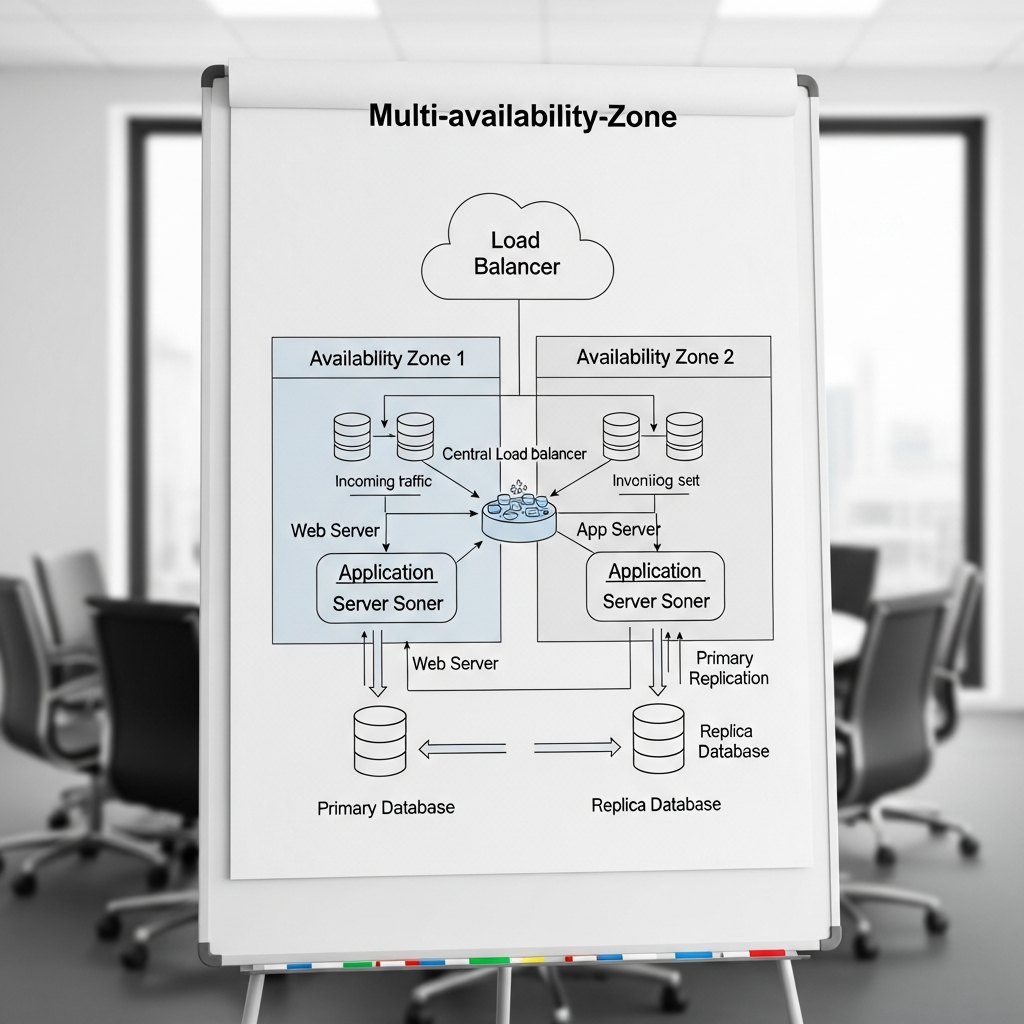
Multi-AZ vs Multi-Region: The Often-Correct Middle Ground
AWS availability zones are physically separate data centers located 10 to 100 kilometers apart. They are isolated from each other for power, cooling, and networking. A single AZ failure does not take down other AZs in the same region.
A well-configured single-region multi-AZ deployment — ALB distributing traffic across 3 AZs, RDS Multi-AZ with automatic failover, ECS tasks spread across AZs — survives individual AZ failures. Those failures are rare but real: they happen, and when they do, a multi-AZ configuration handles them automatically.
The cost comparison tells the story. Multi-AZ achieves 99.95 to 99.99% availability at a 20 to 40% cost premium over single-AZ. Multi-region achieves 99.99%+ availability at a 200 to 300% cost premium over single-AZ. For the vast majority of workloads, multi-AZ delivers sufficient availability at a fraction of the multi-region price.
Multi-region is necessary when you need to survive a full AWS region outage — an event where all AZs in a region go down simultaneously. That has happened, but it is extremely rare. If your risk tolerance and SLA requirements do not demand resilience against a full region failure, multi-AZ is the correct architecture at 5 to 10 times lower cost than multi-region.
Data Replication: The Hardest Part of Multi-Region
If you decide multi-region is justified, data replication is where the complexity lives. Two patterns, and the choice between them shapes everything else in your architecture.
Active-active: Reads and writes happen in both regions simultaneously. This requires conflict resolution for concurrent writes, acceptance of eventual consistency, and careful application design. Active-active is the hardest pattern to implement correctly and the easiest to implement incorrectly. Data conflicts in production are painful to debug and expensive to resolve.
Active-passive: Writes go to the primary region. The secondary region handles reads and serves as a failover target. Simpler than active-active, but failover requires DNS change propagation — 30 to 300 seconds depending on TTL configuration — and there is a potential data loss window equal to your replication lag.
AWS managed services simplify both patterns. DynamoDB Global Tables provides AWS-managed multi-region active-active for key-value data with conflict resolution handled automatically. Aurora Global Database provides active-passive with sub-second replication lag and failover in under 1 minute. Both remove significant engineering effort, but neither eliminates the need to understand your consistency requirements.
Choosing the right replication pattern before writing application code saves months of re-architecture. Get this wrong and you are rebuilding your data layer mid-project.
The Decision Checklist
Go multi-region if: Users in 2 or more geographies with latency sensitivity above 100 milliseconds. Required SLA exceeds 99.99% with regulatory audit requirements. Data residency obligations in multiple geographies. Your data volume and query patterns are compatible with multi-region replication overhead.
Stay single-region multi-AZ if: Your SLA is 99.9% or below. Users are primarily in one geography. Downtime cost is measured in hours of lost revenue, not contractual penalties. No regulatory requirement for multi-region data residency.
Before evaluating multi-region, test your multi-AZ failover. Trigger an AZ failover in a staging environment and measure how your application responds. Most organizations that think they need multi-region actually need to fix their multi-AZ failover configuration — their ALB health checks are too slow, their RDS failover has not been tested, or their ECS task placement constraints are not spreading across AZs correctly. Fix multi-AZ first. If multi-AZ with proper configuration meets your SLA, you just saved yourself a 200% infrastructure cost increase.




Stay in the loop
Get the latest multicloud hosting updates delivered to your inbox.